Rolex Stella Dials: History, Rarity, and Collectible Value of the Day-Date Model
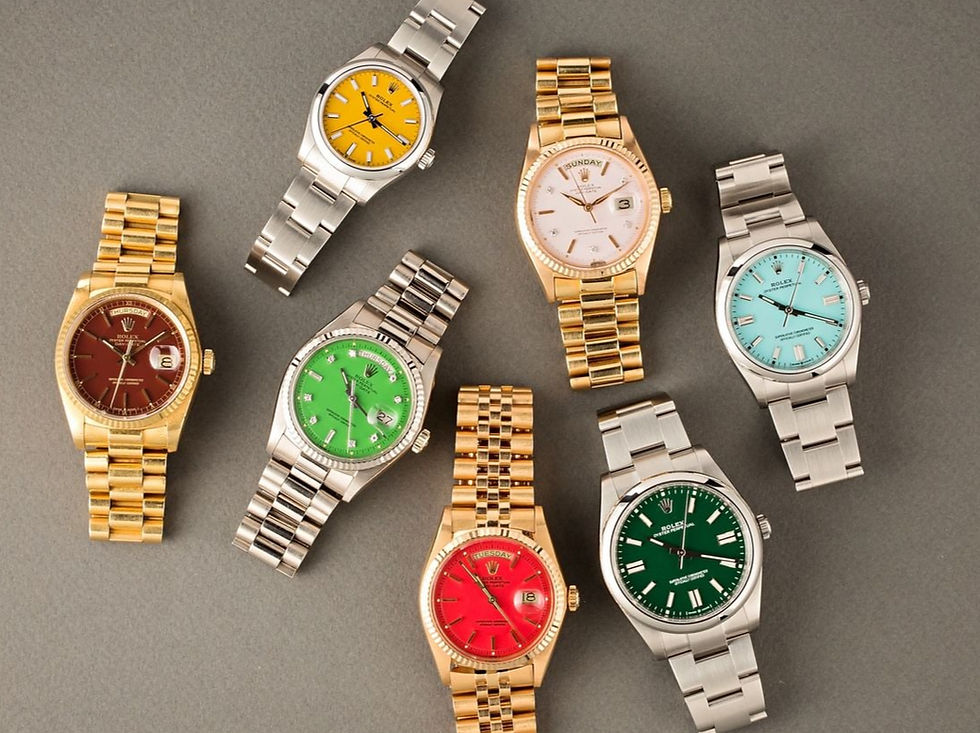
In the world of luxury watches, where classic tones and timeless design dominate, Rolex Stella dials represent an unexpected and bold departure. These vividly colored lacquered dials were developed for the prestigious Day-Date model and are today considered among the most desirable variations of the Rolex line, as well as a true collector’s dream. Although they were not particularly popular at the time of their introduction, their rarity, distinctive aesthetics, and complex production process have elevated them into true collector icons.
The origin of the name “Stella” has long been a subject of debate. One interpretation links it to the Italian word for star, suggesting a reference to the dial’s radiant, glossy appearance, while others associated it with the artist Frank Stella, known for his use of vivid colors. However, the actual origin is far more straightforward, deriving from the Swiss company Stella S.A., the supplier of lacquer used in the production of these dials.
It is important to note that “Stella” was not merely a collector’s nickname. Rolex internally referred to these dials as “Lacquered Stella,” confirming the official nature of the designation. While Stella S.A. supplied the lacquer, the actual dial production was carried out by specialized manufacturers including Stern, Lemrich, and Singer, all of whom were responsible for fabrication, lacquering, and finishing according to Rolex’s strict standards.

The production process of Stella dials required exceptional precision. It began with the manual mixing of lacquer, which led to subtle variations between examples of the same color. The lacquer was then applied to a metal base in multiple sprayed layers, with each layer required to dry completely before the next one was added. This multi-layered structure is what creates the distinctive depth characteristic of Stella dials.
After the pigment layers, a clear top coat was applied and hand-polished to a high gloss. In the dégradé or vignette version, the lacquer was applied on a rotating platform, gradually darkening toward the edges of the dial and creating a smooth gradient effect with enhanced three-dimensional depth.
The printed graphics were added only after the lacquering process using pad printing techniques. Due to the thickness of the lacquer layers, the text often appears to float above the surface of the dial, adding further visual complexity.
Stella dials were produced in two main index configurations. Baton indices featured classic linear markers crafted to match the watch case, while diamond-set indices included brilliant-cut diamonds, often with baguette diamonds at the 6 and 9 o’clock positions. Notably, diamond markers were always set in white gold, regardless of the case material.
Because of the layered lacquering process, small indentations can often be observed around the indices and the Rolex crown, a detail considered characteristic of original production. The condition of the lacquer plays a crucial role in determining value, as cracks, micro-lines, or bubbles can significantly affect collector pricing.

Production of Stella dials began in the late 1960s and continued through the 1970s and 1980s. The earliest examples were used on the 18xx series references, which did not feature a quickset function or sapphire crystal. These early models are often recognized by their so-called “pie-pan” dials with sloped edges, which further enhance the sense of depth created by the lacquer, making them especially desirable among collectors.
Later generations introduced flatter dial designs, changes in luminous materials, and various layout variations, including Roman numeral versions. Interestingly, Stella dials did not require an additional surcharge at the time of production and were simply offered as part of the standard configuration.
In recent years, interest in Stella dials has grown significantly. Collectors increasingly value their uniqueness and bold design language. Although Rolex has reintroduced vibrant colors in modern collections, contemporary models do not possess the same historical significance or level of artisanal craftsmanship as the original Stella pieces.
There is also a rare modern exception: a small, non-commercial series produced in 2013 using the same technique and pad printing methods, reportedly intended for an exclusive circle of collectors and senior executives.
Today, Rolex Stella dials represent a unique chapter in the brand’s history. They embody a rare combination of luxury, experimentation, and artistic expression that was ahead of its time. What was once considered too bold has now become a symbol of individuality and refined collecting taste, making Stella dials some of the most fascinating and sought-after elements in the world of vintage Rolex watches.
Pictures: Bob's Watches


Comments