TAG Heuer Through History: From Edouard Heuer to the First Swiss Watch in Space

The history of Heuer began in 1860 when Edouard Heuer founded his own watchmaking company in La Chaux-de-Fonds, Switzerland. A few years later, he moved operations to his hometown of Brugg, where he opened a workshop under the name Edouard Heuer & Compagnie. He later settled permanently in Biel/Bienne, taking advantage of tax incentives offered to new businesses. In 1869, he secured his first patent for a keyless winding system that allowed pocket watches to be wound using the crown.
The company’s development accelerated in the decades that followed. In 1887, Heuer patented the oscillating pinion, a mechanism that enabled the chronograph to start and stop with a simple push of a button. Variations of this invention remain in use today. Shortly afterward, in 1892, the company introduced its first chronograph, which was showcased the following year at the International Exhibition in Amsterdam.
Following Edouard Heuer’s death, leadership passed to his sons, Jules-Edouard and Charles-Auguste. They continued the company’s innovative tradition and, in 1895, patented one of the earliest water-resistant cases for pocket watches. At the beginning of the 20th century, Heuer expanded into the American market by appointing Henri Freund & Bros. as its exclusive distributor while continuing to introduce new technical advancements.
One of the company’s most notable developments came in 1911 with the launch of the “Time of Trip,” the first dashboard chronograph designed for automobiles and aircraft. Equipped with a multifunction crown positioned at 12 o’clock, it allowed users to track both the current time and journey duration. This innovation paved the way for Heuer’s first wrist chronographs, introduced in 1914. Two years later, the company unveiled the Mikrograph, the world’s first stopwatch capable of measuring time to 1/100th of a second, followed by the Semikrograph and Semicrosplit, which offered even more advanced timing capabilities.
Heuer’s reputation grew further through its involvement with the Olympic Games. Its stopwatches were selected as the official timing instruments for the Antwerp Games in 1920, Paris in 1924, and Amsterdam in 1928. The brand’s close association with sports and motor racing contributed significantly to its success during the 1920s, a period when the now-famous shield logo also began appearing on its watches.

Despite the economic challenges brought by the Great Depression, Heuer continued production throughout the 1930s. In 1933, the company introduced the Autavia, a timing instrument designed for automobiles and aviation, whose name combined the words “automobile” and “aviation.” During the same decade, Heuer developed dedicated pilot chronographs designed from the ground up as wristwatches rather than modified pocket watches. In 1934, the brand exhibited at the Basel Watch Fair for the first time, and by the end of the decade, the water resistance of its chronographs had been significantly improved through redesigned pushers.
The reputation of Heuer chronographs continued to grow during the 1940s. Among their notable owners were future U.S. President Dwight Eisenhower and President Harry Truman. In 1948, the company launched the Auto-Graph, a chronograph featuring an adjustable scale designed for various applications, including sports. This was followed by the Solunar, developed at the request of Abercrombie & Fitch to display tide information, and the Mareograph, known in the United States as the Seafarer, the first chronograph with a tide indicator and regatta timer.
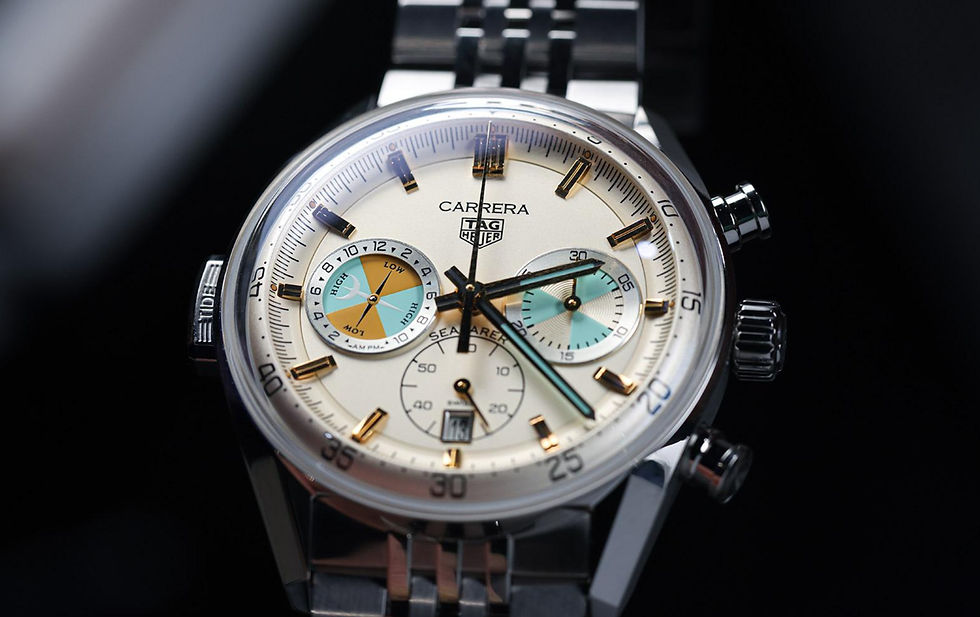
Heuer also continued producing timing instruments for automobiles, aircraft, and boats. In 1958, it introduced a complete new range of dashboard timers and clocks. The same year marked the arrival of Jack Heuer, a fourth-generation family member whose influence would prove pivotal in shaping some of the company’s most iconic watches.
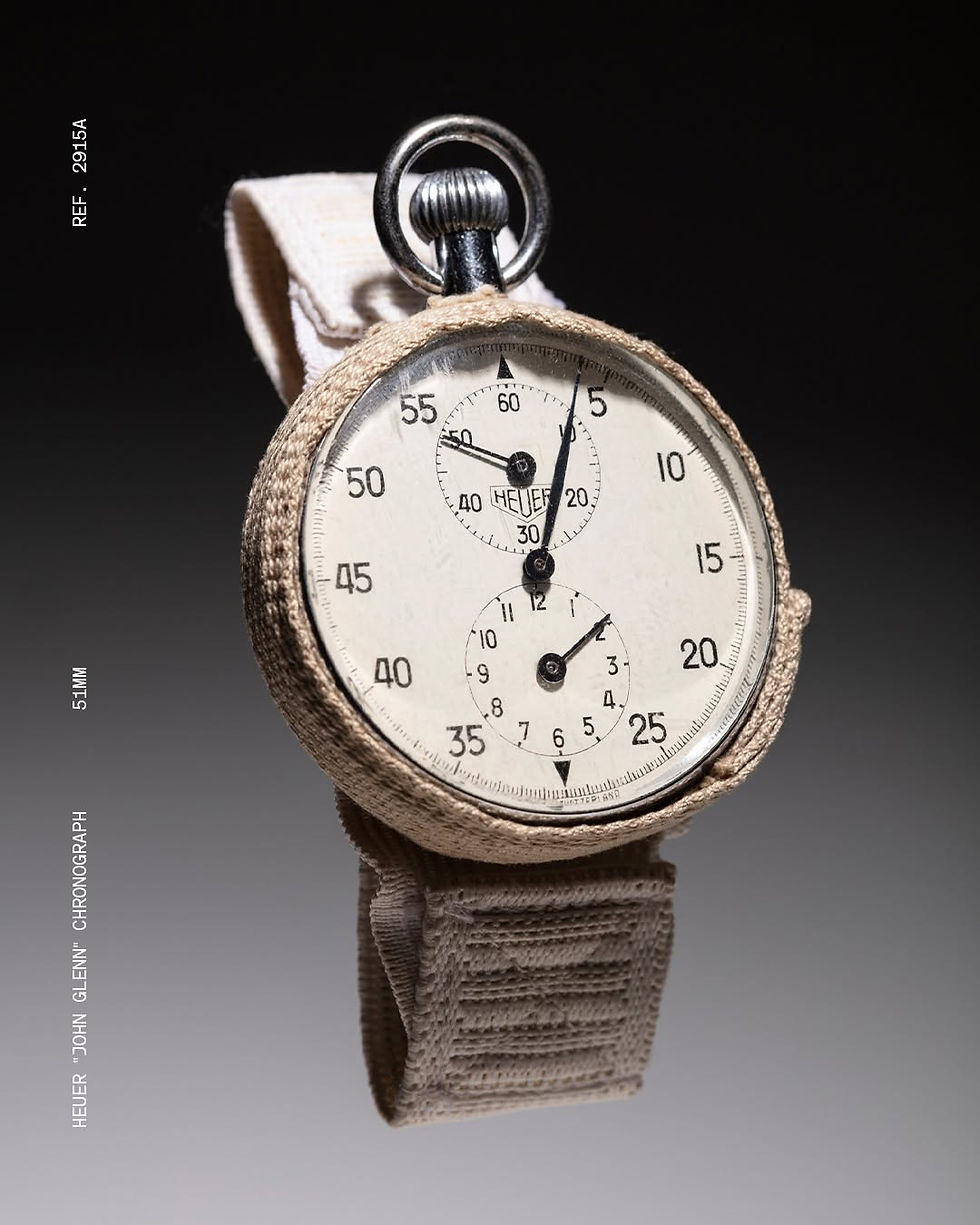
In the early 1960s, Jack Heuer initiated the development of a wrist chronograph with a rotating bezel called the Autavia. The first generation debuted in 1962 and quickly became popular among Formula 1 drivers. That same year, Heuer made history when astronaut John Glenn wore a Heuer stopwatch during the Mercury mission, making the brand the first Swiss watchmaker to travel into space.
The following year saw the introduction of the Carrera, a chronograph inspired by the legendary Carrera Panamericana road race. Designed with readability and functionality in mind, it soon became one of the most celebrated watches in the brand’s history. Around the same time, Heuer partnered with Buren, Dubois Depraz, and Breitling to develop the world’s first automatic chronograph movement. The result was the revolutionary Calibre 11, which would later power the Autavia, Carrera, and Monaco.
The Monaco attracted further attention thanks to its groundbreaking square water-resistant case for an automatic chronograph. Its crown, positioned on the left side, served as a visual reminder that the watch did not require manual winding. During the 1970s, Heuer expanded its automatic chronograph lineup with models such as the Daytona, Montreal, Silverstone, Calculator, Monza, and Jarama. The brand became increasingly associated with motorsport, aided by Steve McQueen’s use of the Monaco in the film Le Mans and Heuer’s partnership with Ferrari’s Formula 1 team.

At the same time, the company invested heavily in electronic and quartz technology. In 1973, the Microsplit 820 became the first quartz-powered digital sports timer. Between 1975 and 1982, Heuer produced a range of successful digital watches, including the Chronosplit Manhattan GMT, which combined traditional analog timekeeping with digital chronograph and second-time-zone functions.
The early 1980s brought the introduction of the 2000 Series, a professional sports watch collection featuring 200-meter water resistance, sapphire crystal, and a unidirectional rotating bezel. It was among the last major projects developed while Jack Heuer remained at the helm of the company before he was forced to sell his stake during the Swiss watch industry crisis. In 1985, the company was acquired by TAG (Techniques d’Avant Garde), and on January 1, 1986, it officially became TAG Heuer. The first model launched under the new identity was the Formula 1, a quartz watch inspired by contemporary trends and the success of colorful, affordable sports watches. By 2000, more than three million Formula 1 watches had been sold.
The S/el collection followed in 1987, distinguished by its S-shaped bracelet links. It was later renamed Link and remains an important part of the brand’s lineup. Strong sales helped drive revenue growth from 66 million Swiss francs in 1988 to 420 million in 1996.

By the late 1990s, TAG Heuer increasingly drew inspiration from its own heritage. The Re-Edition collection reintroduced modern interpretations of classic Carrera and Monaco models. To promote the Monaco, the company secured the rights to use the image of Steve McQueen through his son, Chad McQueen. In 1999, the luxury group LVMH acquired a controlling stake in TAG Heuer, although the company continued operating independently.
The early 2000s brought new releases such as the Monza re-edition and the Monaco Sixty-Nine concept. Significant attention was generated by the Monaco V4 Concept in 2004, which entered limited production five years later. That same year also saw the introduction of the 2000 Aquaracer, a model that would eventually lend its name to the entire Aquaracer collection.
The company’s 150th anniversary in 2010 was marked by the launch of the in-house Calibre 1887 chronograph movement and the Grand Carrera Pendulum Concept. These innovations were followed by the Mikrograph, capable of measuring 1/100th of a second, the Mikrotimer Flying 1000, accurate to 1/1000th of a second, and the Mikrogirder, which won the prestigious Aiguille d’Or award at the Grand Prix d’Horlogerie de Genève in 2012.
TAG Heuer introduced the Carrera Calibre Heuer 01 in 2015, revived the Autavia in 2017 with the Heuer 02 movement, and incorporated the same caliber into the Monaco in 2019. A new generation of the diving watch, the Aquaracer Professional 300, arrived in 2021. Two years later, to celebrate the 60th anniversary of the Carrera, TAG Heuer unveiled the Carrera Chronograph Glassbox in a 39 mm case, continuing the legacy of one of its most iconic timepieces.
Pictures: Tag Heuer, Oracle Time, On The Dash


Comments